

Prefer to Listen? Press Play Below
For your convenience, this blogpost is also available as an audio version. Simply click the play button to listen (Duration: 10 minutes and 30 seconds)
Author: Damianos Michailidis | Project Manager at Rainno
The success of a product or business is, by nature, fragile. The world is constantly changing at an exhilarating pace, with technological breakthroughs, environmental challenges, regulatory upheavals and geopolitical risks being some of the forces that can undermine organisational success. The world is becoming increasingly more turbulent, with “black swan” events, like wars and natural disasters, happening with increasing regularity.
In previous articles, we discussed the importance of bioeconomy, the environmental benefits of bio-based products and the complexities of their value chains. In this one, we will explore why resilience in bio-based supply chains is currently a strategic necessity rather than an optional luxury.
The concept of resilience for organisations and supply chains has been around for more than two decades now. In a 2003 Harvard Business Review article, it was defined as “the ability to dynamically reinvent business models and strategies as circumstances change, to continuously anticipate and adjust to changes that threaten their (firms’) core earning powers – and to change before the need becomes desperately obvious”[1]. The key word here is before it becomes desperately obvious.
Essentially, it means an organisation’s ability to quickly absorb shocks, adapt and recover from a crisis. The timely establishment of resilience mechanisms before a crisis hits is crucial for minimising its negative effects. Companies should continuously assess their resilience and try to prepare but this is, at times, a goal that can conflict with another important part of their operations, efficiency. By default, efficiency is about achieving the most beneficial result with the least amount of effort/cost. On the other hand, resilience is about being redundant with safety measures, in case something goes wrong[2].
Let’s use a bio-plastics company in France as an example.
France is the major corn growing country in Europe, so this company is producing polylactic acid (PLA), using corn starch as feedstock, sourced from one big supplier in the South. This is economically efficient since the concentrated sourcing allows the company to minimise transport costs, ensure consistent starch quality, and provide a good product with a high profit margin, thanks to economies of scale. But this approach undermines the company’s organisational resilience. A drought or pest outbreak affecting the supplier’s region can sharply reduce corn availability, collapsing their supply chain. A more resilient strategy would be for the company to diversify its inputs using wheat or sugar beet, or source corn feedstock from multiple regions. This would allow them to easily overcome future corn availability issues but will increase overall costs and logistical complexity.
Bio-based supply chains’ resilience challenges
From the above example, we can see that the answer to the question of ‘What the company should do?’ is not clear cut. We could probably agree that not preparing at all is not the right strategy, despite being the most profitable in the short term. But how much should they prepare? Should they just find a few more suppliers from a different region in France or Europe, or should they experiment with using alternative inputs for their production like sugarcane? Or maybe both? What quantities should they store?
This is an example of just one issue that a company faces that doesn’t have a clear answer. Bio-based products face numerous supply chain challenges like the seasonality of biomass supply, the fragmented markets for bio-based materials and the limited traceability and transparency of sourcing and production methods in their supply chain. If you are interested in a more detailed analysis of bio-based value chains and their challenges, you can read our previous article about the subject here.
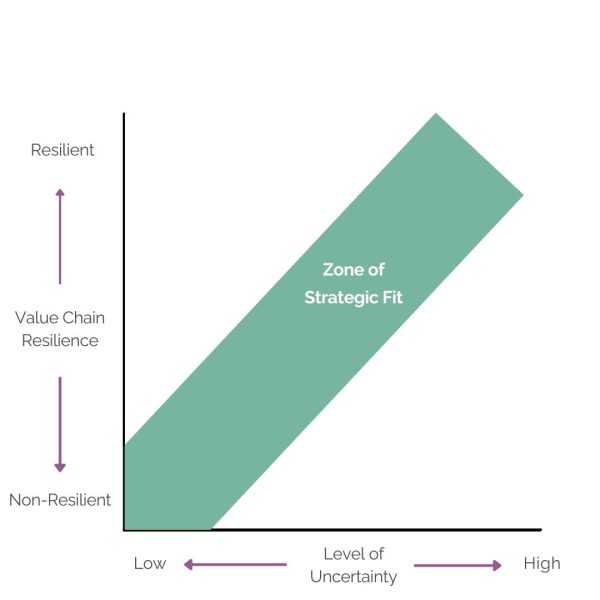
The main challenge then becomes to identify a ‘strategic fit’ with regard to the resilience measures that a company should implement. In Figure 1 you can see a visualisation of this approach[3]. The idea of strategic fit helps determine the necessary resilience actions and it refers to matching a chain’s capabilities with the level of uncertainty it faces. When demand is stable and supply risks are low, only a few actions are required, and the chain can focus more on efficiency. As uncertainty increases however, stronger resilience measures are needed to face potential disruptions. Some value chains already have natural advantages, such as relying on more resilient crops as feedstock, which allow them to perform well even in more uncertain conditions. The goal is to operate within the ‘zone of strategic fit’, where resilience and uncertainty are balanced effectively.
Building Resilience
To strengthen the resilience of a bio-based supply chain we need to fully map it, define vulnerabilities and prioritise in preparing for the scenarios with the most adverse effects. This prioritisation is what will allow for a balance of operational efficiency and resilience measures. Specifically for bio-based products, there are some broader strategic approaches that can help bio-based producers to adapt and safeguard their operations in an increasingly unpredictable environment. Those are:
- Diversify feedstock sources: We touched upon this first point in our example. Because the supply of biomass is highly dependent on agricultural cycles and forest management practices, availability is often an issue. Diversifying both in terms of different feedstocks and supplier regions can give producers a “buffer” for when one feedstock is not available or one region faces shortages[1].
- Ensure traceability and transparency of sourcing and production methods: For a bio-based supply chain to be resilient, it needs to be able to know where their materials are coming from and showcase that their processes are actually environmentally friendly and sustainable. Companies need to do their due diligence, while also supporting collaboration and data sharing between suppliers and producers. This is crucial because the actual sustainability of bio-based products depends on a wide range of conditions along their life cycle that need to be assessed and showcased to avoid “greenwashing” and earn consumers’ trust[2].
- Integrating digital tools for monitoring and forecasting: Technology can play a crucial role in assisting bio-based chains to grow and thrive. Tools like AI, IoT sensors, data analytics and environmental modelling can help actors to better monitor supply disruptions, and ensure early troubleshooting and smoother operations. Supply chain and production data can also be used to prove sustainability claims[3].
The overall bioeconomy was proven to be relatively resilient. For example, it absorbed the shock from the initial stage of the pandemic in 2020 better than the EU average (-0.4% decline in total value vs -4.0% decline to the EU average). This does not paint an accurate picture however, since if we look at specific industries, the sector performance was quite heterogeneous, proving there is still a lot of work to be done[4].
Why resilience matters for the transition to a circular bioeconomy?
Building a more resilient supply chain will allow the bio-based sector to achieve sustainable long-term growth. It will enable wider uptake of bio-products from manufacturers and consumers through stable product supply and credibility.
In ARGONAUT we strive to create tools that can support informed decision-making and can help build sectoral resilience. We also publish informative articles like this one to better inform people about bio-products and technology. If you want to be kept in the loop of what we are developing and publishing you can subscribe to our Newsletter.
You can also learn more about the project and the innovative JASON AI-powered tool that we are developing here.
Footnotes
[1] Hamel, G., & Valikangas, L. (2003). The quest for resilience. icade. Revista de la Facultad de Derecho, (62), 355-358. p1
[2] Jin, A. S., Trump, B. D., Golan, M., Hynes, W., Young, M., & Linkov, I. (2021). Building resilience will require compromise on efficiency. Nature Energy, 6(11), 997-999.
[3] Vroegindewey, R., & Hodbod, J. (2018). Resilience of Agricultural Value Chains in Developing Country Contexts: A Framework and Assessment Approach Sustainability, 10(4), 916.
[4] Jabbarzadeh, A., & Shamsi, M. (2025). Designing a resilient and sustainable multi-feedstock bioethanol supply chain: Integration of mathematical modeling and machine learning. Applied Energy, 377, 123794.
[5] Ali, I., Golgeci, I., & Arslan, A. (2023). Achieving resilience through knowledge management practices and risk management culture in agri-food supply chains. Supply Chain Management: An International Journal, 28(2), 284-299.
[6] Setyadi, A., Pawirosumarto, S., & Damaris, A. (2025). Toward a resilient and sustainable supply chain: Operational responses to global disruptions in the post-COVID-19 era. Sustainability, 17(13), 6167.
[7] Lasarte-López, J., Grassano, N., M’barek, R., & Ronzon, T. (2023). Bioeconomy and resilience to economic shocks: insights from the COVID-19 pandemic in 2020. Bio-Based and Applied Economics, 12(4), 367-377.

FREQUENTLY ASKED QUESTIONS | What People Often Ask
- What are the main drivers for the development of bio-based value chains?
The two most important drivers are the potential for feedstock diversification (moving away from fossil resources) and the ability to introduce new functionalities in products.
Find out more about development of the development of bio-based value chains
- What is the value chain of a product?
The Value Chain is a model, originally proposed by Michael Porter, that describes the full range of activities required to bring a product or service from conception through the different phases of production, delivery to final consumers, and final disposal/recycling.
Find out more about the value chain of a product
- What are examples of bio-based products?
Bio-based products are wholly or partly derived from renewable biological resources (biomass), such as plants, algae, animals, or various types of organic waste, and are generally an alternative to petroleum-derived products. Examples include:
Find out more about the bio-based products
